"Our long-range responses had a very significant impact in the Moscow region last night. One of Russia's key oil industry facilities and the aggressor's logistics facility were hit. These are billions of dollars that sustain the war machine. The systems used included FP-1, RZ-100, MICH-2000, Palianytsia, Vendetta, Liutyi, Bars, Flamingo, Sichen, and Pelican."

~ President of Ukraine Volodymyr Zelensky, September 20, 2026 ~

On September 20, the final day of voting in Russia's parliamentary elections, Ukraine launched more than 1,000 drones into Russia. According to Moscow's mayor, it was the largest drone attack the city has ever faced. A Moscow refinery and a residential building were damaged. More than half of the ten weapons Zelenskyy named in his social media post were new attack drones, and the rest were missile systems. It is rare for a head of state to call out weapon systems by name, one after another. Beyond public messaging and psychological warfare, the move declared to the world that Ukraine's defense self-reliance has already made major breakthroughs in drones and the defense industry.

For more than four years, Russia's full-scale invasion has forced Ukraine to become a fierce military-industrial power, one that has built a drone ecosystem linking the Ministry of Defense, the Security Service of Ukraine, the Unmanned Systems Forces, the Special Operations Forces, the Main Directorate of Intelligence, and the Ministry of Digital Transformation. So I went to Ukraine to see it for myself.

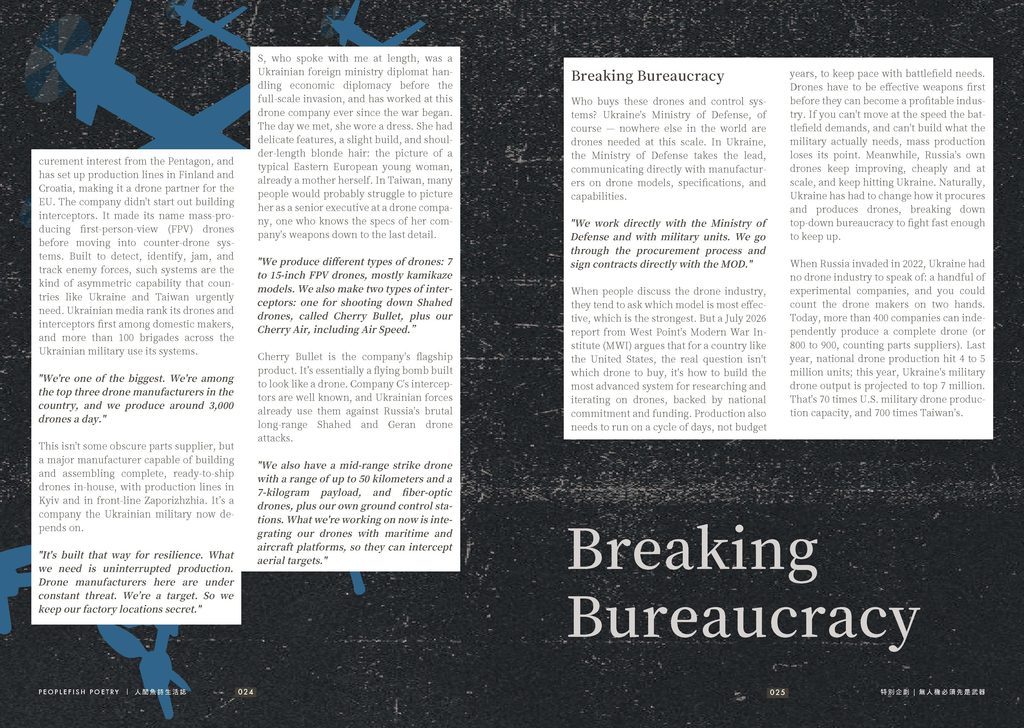
In May 2026, on a sweltering afternoon, I met a representative of Company C in Kyiv. The company was founded in 2022 in Zaporizhzhia. More than half of that region's territory, along with its nuclear plant, has remained under Russian occupation since the full-scale invasion. Company C is now one of Ukraine's top drone manufacturers. It has already won procurement interest from the Pentagon, and has set up production lines in Finland and Croatia, making it a drone partner for the EU. The company didn't start out building interceptors. It made its name mass-producing first-person-view (FPV) drones before moving into counter-drone systems. Built to detect, identify, jam, and track enemy forces, such systems are the kind of asymmetric capability that countries like Ukraine and Taiwan urgently need. Ukrainian media rank its drones and interceptors first among domestic makers, and more than 100 brigades across the Ukrainian military use its systems.

"We're one of the biggest. We're among the top three drone manufacturers in the country, and we produce around 3,000 drones a day."

This isn't some obscure parts supplier, but a major manufacturer capable of building and assembling complete, ready-to-ship drones in-house, with production lines in Kyiv and in front-line Zaporizhzhia. It’s a company the Ukrainian military now depends on.

"It's built that way for resilience. What we need is uninterrupted production. Drone manufacturers here are under constant threat. We’re a target. So we keep our factory locations secret."

S, who spoke with me at length, was a Ukrainian foreign ministry diplomat handling economic diplomacy before the full-scale invasion, and has worked at this drone company ever since the war began. The day we met, she wore a dress. She had delicate features, a slight build, and shoulder-length blonde hair: the picture of a typical Eastern European young woman, already a mother herself. In Taiwan, many people would probably struggle to picture her as a senior executive at a drone company, one who knows the specs of her company's weapons down to the last detail.

"We produce different types of drones: 7 to 15-inch FPV drones, mostly kamikaze models. We also make two types of interceptors: one for shooting down Shahed drones, called Cherry Bullet, plus our Cherry Air, including Air Speed.”

Cherry Bullet is the company's flagship product. It’s essentially a flying bomb built to look like a drone. Company C's interceptors are well known, and Ukrainian forces already use them against Russia's brutal long-range Shahed and Geran drone attacks.

"We also have a mid-range strike drone with a range of up to 50 kilometers and a 7-kilogram payload, and fiber-optic drones, plus our own ground control stations. What we're working on now is integrating our drones with maritime and aircraft platforms, so they can intercept aerial targets."
Breaking Bureaucracy

Who buys these drones and control systems? Ukraine's Ministry of Defense, of course — nowhere else in the world are drones needed at this scale. In Ukraine, the Ministry of Defense takes the lead, communicating directly with manufacturers on drone models, specifications, and capabilities.

"We work directly with the Ministry of Defense and with military units. We go through the procurement process and sign contracts directly with the MOD."

When people discuss the drone industry, they tend to ask which model is most effective, which is the strongest. But a July 2026 report from West Point's Modern War Institute (MWI) argues that for a country like the United States, the real question isn't which drone to buy, it's how to build the most advanced system for researching and iterating on drones, backed by national commitment and funding. Production also needs to run on a cycle of days, not budget years, to keep pace with battlefield needs. Drones have to be effective weapons first before they can become a profitable industry. If you can't move at the speed the battlefield demands, and can't build what the military actually needs, mass production loses its point. Meanwhile, Russia's own drones keep improving, cheaply and at scale, and keep hitting Ukraine. Naturally, Ukraine has had to change how it procures and produces drones, breaking down top-down bureaucracy to fight fast enough to keep up.

When Russia invaded in 2022, Ukraine had no drone industry to speak of: a handful of experimental companies, and you could count the drone makers on two hands. Today, more than 400 companies can independently produce a complete drone (or 800 to 900, counting parts suppliers). Last year, national drone production hit 4 to 5 million units; this year, Ukraine's military drone output is projected to top 7 million. That's 70 times U.S. military drone production capacity, and 700 times Taiwan's.

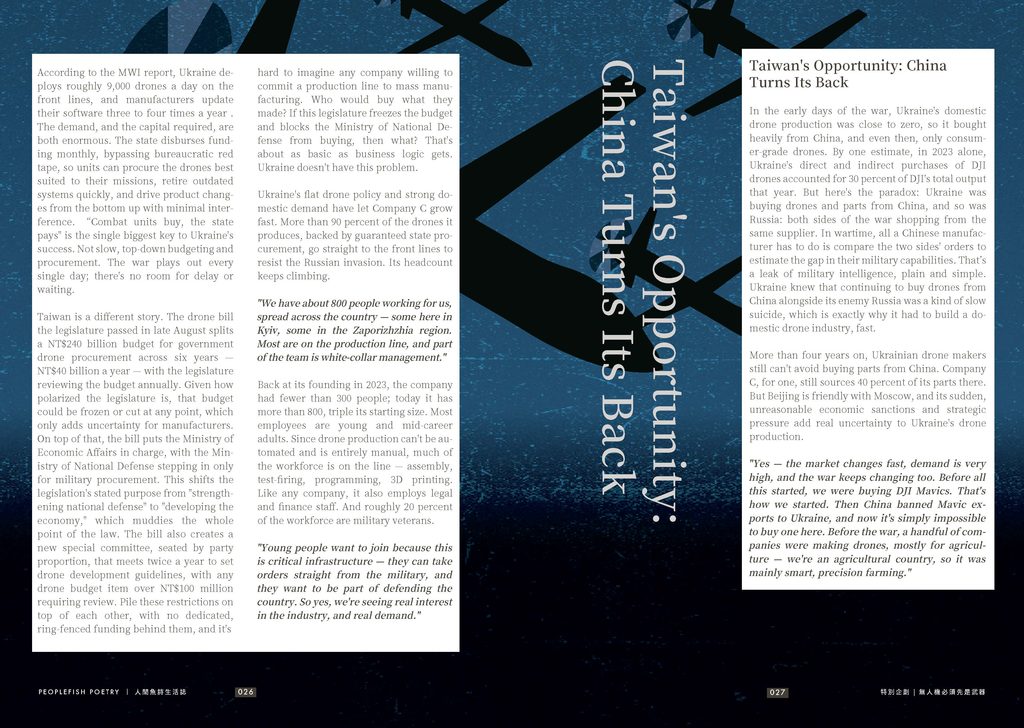
According to the MWI report, Ukraine deploys roughly 9,000 drones a day on the front lines, and manufacturers update their software three to four times a year . The demand, and the capital required, are both enormous. The state disburses funding monthly, bypassing bureaucratic red tape, so units can procure the drones best suited to their missions, retire outdated systems quickly, and drive product changes from the bottom up with minimal interference. “Combat units buy, the state pays" is the single biggest key to Ukraine's success. Not slow, top-down budgeting and procurement. The war plays out every single day; there's no room for delay or waiting.

Taiwan is a different story. The drone bill the legislature passed in late August splits a NT$240 billion budget for government drone procurement across six years — NT$40 billion a year — with the legislature reviewing the budget annually. Given how polarized the legislature is, that budget could be frozen or cut at any point, which only adds uncertainty for manufacturers. On top of that, the bill puts the Ministry of Economic Affairs in charge, with the Ministry of National Defense stepping in only for military procurement. This shifts the legislation's stated purpose from "strengthening national defense" to "developing the economy," which muddies the whole point of the law. The bill also creates a new special committee, seated by party proportion, that meets twice a year to set drone development guidelines, with any drone budget item over NT$100 million requiring review. Pile these restrictions on top of each other, with no dedicated, ring-fenced funding behind them, and it's hard to imagine any company willing to commit a production line to mass manufacturing. Who would buy what they made? If this legislature freezes the budget and blocks the Ministry of National Defense from buying, then what? That's about as basic as business logic gets. Ukraine doesn't have this problem.

Ukraine's flat drone policy and strong domestic demand have let Company C grow fast. More than 90 percent of the drones it produces, backed by guaranteed state procurement, go straight to the front lines to resist the Russian invasion. Its headcount keeps climbing.

"We have about 800 people working for us, spread across the country — some here in Kyiv, some in the Zaporizhzhia region. Most are on the production line, and part of the team is white-collar management."

Back at its founding in 2023, the company had fewer than 300 people; today it has more than 800, triple its starting size. Most employees are young and mid-career adults. Since drone production can't be automated and is entirely manual, much of the workforce is on the line — assembly, test-firing, programming, 3D printing. Like any company, it also employs legal and finance staff. And roughly 20 percent of the workforce are military veterans.

"Young people want to join because this is critical infrastructure — they can take orders straight from the military, and they want to be part of defending the country. So yes, we're seeing real interest in the industry, and real demand."
Taiwan's Opportunity: China Turns Its Back

In the early days of the war, Ukraine's domestic drone production was close to zero, so it bought heavily from China, and even then, only consumer-grade drones. By one estimate, in 2023 alone, Ukraine's direct and indirect purchases of DJI drones accounted for 30 percent of DJI's total output that year. But here's the paradox: Ukraine was buying drones and parts from China, and so was Russia: both sides of the war shopping from the same supplier. In wartime, all a Chinese manufacturer has to do is compare the two sides' orders to estimate the gap in their military capabilities. That’s a leak of military intelligence, plain and simple. Ukraine knew that continuing to buy drones from China alongside its enemy Russia was a kind of slow suicide, which is exactly why it had to build a domestic drone industry, fast.

More than four years on, Ukrainian drone makers still can't avoid buying parts from China. Company C, for one, still sources 40 percent of its parts there. But Beijing is friendly with Moscow, and its sudden, unreasonable economic sanctions and strategic pressure add real uncertainty to Ukraine's drone production.

"Yes — the market changes fast, demand is very high, and the war keeps changing too. Before all this started, we were buying DJI Mavics. That's how we started. Then China banned Mavic exports to Ukraine, and now it's simply impossible to buy one here. Before the war, a handful of companies were making drones, mostly for agriculture — we're an agricultural country, so it was mainly smart, precision farming."

Because Beijing sided with Moscow and banned drone exports to Ukraine, Ukrainians finally woke up and started building their own. A supply chain free of Chinese components is a real goal, just one that's still hard to reach.

"To secure stable supply — we still rely heavily on China, for both parts and components."

Company C still sources 40 percent of its parts from China. It's eager to break that dependence, but the low price of Chinese drone components is a wall other countries can't easily get past. For Taiwan to break into the non-Chinese supply chain that Europe, the U.S., and Ukraine want, price is the biggest obstacle.

"We're constantly looking for partners in Europe and Asia. Unfortunately, Chinese components are still very high quality, and very price competitive."

For Ukrainian drone companies, Chinese parts outperform those from Europe and Asia, including Taiwan and Japan, on both quality and price. Parts from Taiwan, among others, are still too expensive. Even so, manufacturers haven't given up looking for alternatives to Chinese components.

"So we're looking for partners for joint production or joint development, and for backup sources of parts, because supply from China is very unstable. We can't rely on it — we've already run into problems there, like China simply refusing to sell or export."

So which parts are Ukrainian manufacturers actually looking for?

"We're very interested in cameras, control systems, control chips, communications — and batteries or engines."

Does Company C have any advice for Taiwan?

"Decentralize production."

That was her immediate, first response.

"Decentralize production. Make sure you have a stable supply chain. Aim to innovate, not to be perfect — it just has to work. That's what matters."

That's a common refrain among Ukrainian drone companies, because production instability comes down to one thing: Beijing can turn on you in an instant.

"For example, this past January, we ran out of fiber optics because China halted all exports for a while. By the time they resumed, prices had nearly doubled. Of course that creates problems — economic warfare is the cruelest kind, you know."

That's exactly why Ukraine, alongside Europe and the U.S., needs a backup supply chain free of Chinese components. But is Taiwan actually ready?

Ukraine's drone industry is actively looking toward Asian markets — whether to source parts there or sell drones to Asian countries, and that's an opening for Taiwan's own drone industry. For Ukraine's drone industry, the greatest enemy is "time." For Taiwan's, it's "the legislature." Ukraine's national drone policy rests on decentralized power, flat decision-making, and military-led procurement, with the military deciding and the government paying. Four years running, that policy has made Company C stronger every year, to the point that it's caught the Pentagon's attention and set up a production line in NATO member Finland. Taiwan's drone industry, by contrast, is still stuck in the mud, and risks missing its moment.

The intent behind Taiwan's version of the drone bill has drifted away from the reality Taiwan actually faces. But the war, and the threat, are already here.